Deliverable 3 · Service blueprint
Eleven stages, four lanes, ten failure points
Denise does the hardest work alone, at night, after support closes. Most failure points sit in her lane during setup and overnight. The last two sit with her doctor.
Scroll sideways to see all stages. Open the SVG on its own.
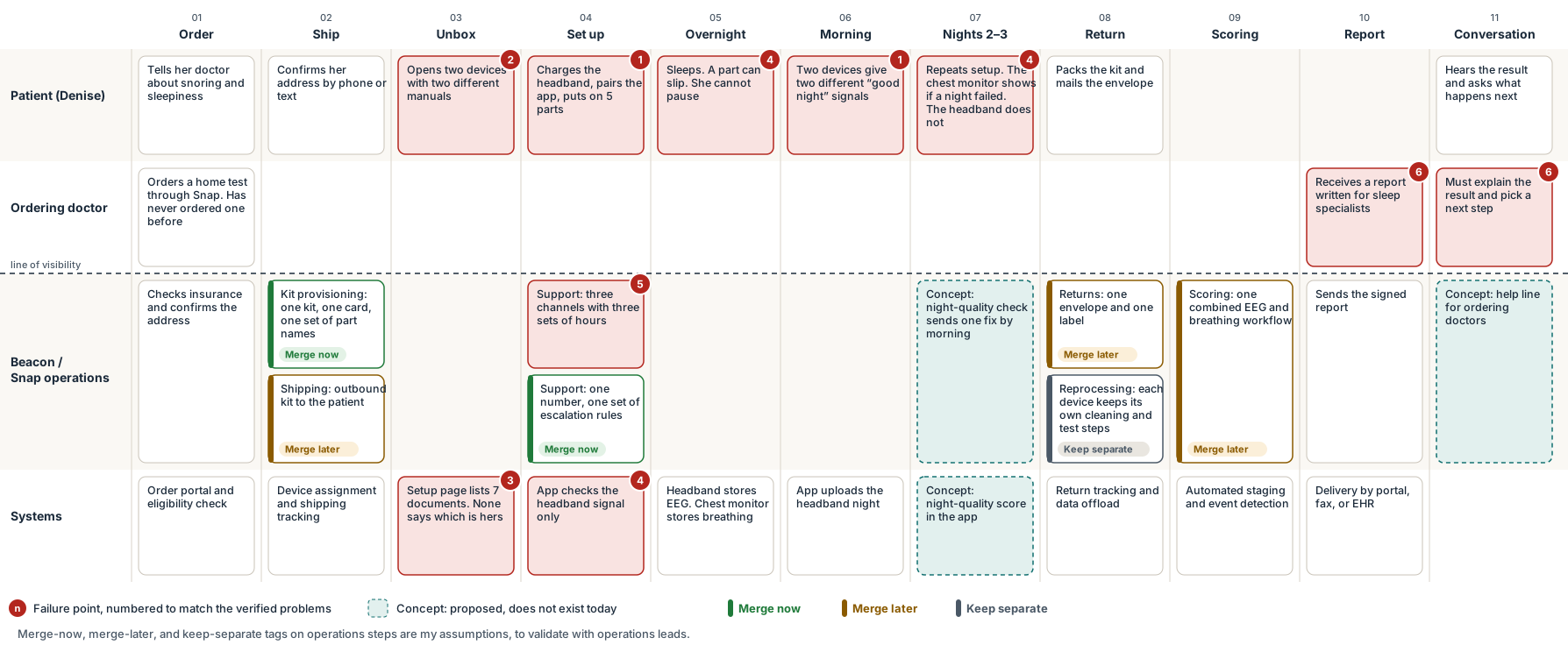
Failure points
- 1Two status languages. The headband glows white, green, or ruby and beeps. The chest monitor shows green, amber, or red per sensor and circles its lights in the morning. Appears at set up and morning.
- 2Manual written for three audiences. Part numbers, regulatory symbols, and three names for one part. Appears at unboxing.
- 3Setup page asks patients to choose. Seven documents across four device versions, plus an older app. Appears at unboxing.
- 4No single go signal; no pause. The app checks the headband. The chest monitor runs its own Sensor Check and Smart Check. Once recording starts, a slipped part costs the night. Appears at set up, overnight, and nights 2–3.
- 5Three support channels, three sets of hours. The headband manual lists an email address. The SleepView line is open weekdays 8am–8pm Eastern, which is 5pm in Fresno. Snap advertises 24/7 phone support. Appears at set up.
- 6Specialist report, generalist reader. Assumption The doctor gets a report built for sleep physicians and has to choose the next step. Appears at report and conversation.
Merge, merge later, or keep separate
The operations lane is tagged with the order I would close each seam in. Patient-visible seams come first. Seams only staff can see wait until the patient-facing ones are closed. Assumption Every tag is mine, to validate with operations leads.
| Operations step | Tag | Reason |
|---|---|---|
| Kit provisioning | Merge now | One kit needs one packing spec, so the card, part names, and app login match what is in the box. |
| Support | Merge now | Patients meet this seam at bedtime, so one number and one set of escalation rules come first. |
| Shipping | Merge later | Patients rarely notice the carrier, and existing contracts already work. |
| Returns | Merge later | One envelope and label matter to the patient; back-office routing can follow. |
| Scoring | Merge later | One report needs one combined EEG and breathing workflow, and that workflow needs validation first. |
| Reprocessing | Keep separate | Each device has its own cleaning and test procedure, and those belong to that device. |
Sources for each point are on the case study page. Teal dashed boxes are concept proposals that do not exist today.
Text version of the blueprint
| Stage | Patient | Ordering doctor | Operations | Systems |
|---|---|---|---|---|
| Order | Tells her doctor about snoring and sleepiness | Orders a home test through Snap | Checks insurance, confirms address | Order portal, eligibility |
| Ship | Confirms address | Kit provisioning (merge now); shipping (merge later) | Tracking | |
| Unbox | Two devices, two manuals ⚠2 | Setup page lists 7 documents ⚠3 | ||
| Set up | Charges, pairs, puts on 5 parts ⚠1 | Three support channels ⚠5; one number (merge now) | App checks headband only ⚠4 | |
| Overnight | Part can slip; no pause ⚠4 | Both devices record | ||
| Morning | Two different "good night" signals ⚠1 | App uploads | ||
| Nights 2–3 | Chest monitor shows a failed night; headband does not ⚠4 | Concept: one fix by morning | Concept: night-quality score | |
| Return | Mails kit | Returns (merge later); reprocessing (keep separate) | Return tracking | |
| Scoring | Scoring: one combined workflow (merge later) | Automated staging | ||
| Report | Specialist-style report ⚠6 | Sends report | Portal, fax, EHR | |
| Conversation | Asks what happens next | Explains, picks next step ⚠6 | Concept: doctor help line |