Getting Denise to a usable night, and her doctor to a decision
An EEG home sleep test fails in two places: the bedroom at 10pm, and the doctor's inbox a week later. I designed for both in one day, from desk research.
Roger Wong · October 2026Concept for a 2027 servicePlaceholder data throughout
Denise's story
Denise is 56 and lives in Fresno. She snores loudly and nods off at her desk after lunch. Her primary care doctor has never ordered a sleep study.
In 2027 the doctor orders one through Snap Diagnostics, which Beacon Biosignals acquired on October 22, 2026. Denise gets a kit with two devices: an EEG headband, and a chest monitor with a belt, nose tube, and finger clip. She sets both up alone at bedtime, sleeps up to three nights, and mails the kit back. Her doctor gets a report and decides what's next.
Where it goes wrong:
The two devices use two different light systems.
The headband recording can't be paused, so a slipped headband costs the night.
Help depends on which channel she finds: an email address, a line that closes at 5pm her time, or Snap's 24/7 line.
Her doctor, new to sleep medicine, may get a report written for specialists.
Order
Ship
Unbox
Set up
Overnight
Morning
Nights 2–3
Return
Scoring
Report
Conversation
In one practitioner poll, 42% of unusable home tests came from setup errors and 38% from errors after setup, like a sensor falling off (Sleep Review).
The blueprint
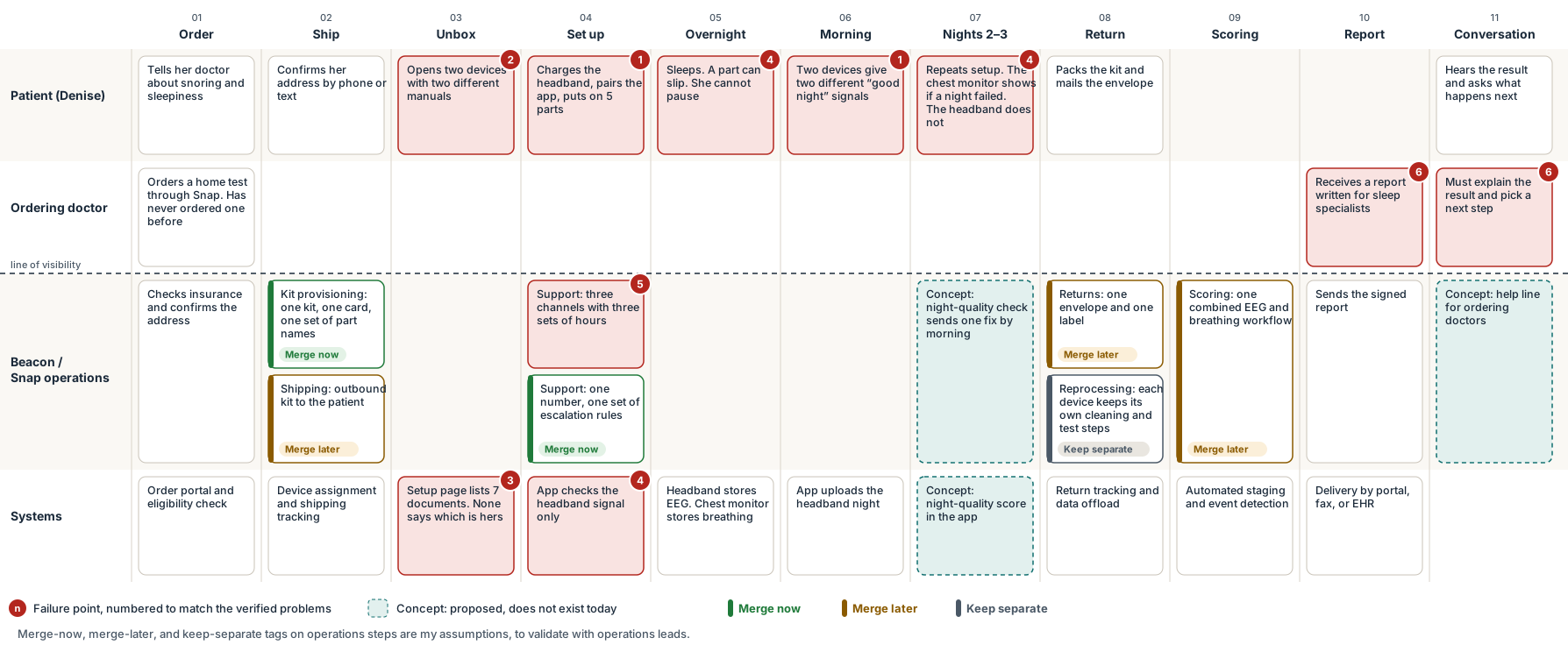
Most failure points sit in Denise's lane, from unboxing to morning. Two sit with her doctor. Teal boxes are new proposals: a morning check that sends one fix, and a help line for ordering doctors.
The 2027 kit is the first product to draw on all three companies Beacon has brought together since 2023. Every acquisition leaves seams. The design job is to find the ones Denise and her doctor notice, then pick the order to close them.
Primary care ordering, scoring, interpretation, billing
2027: EEG home sleep test, ordered by primary care
[2] is a company database, not a Beacon source. The old headband's model number (3SCL1MD, in the Waveband 0 IFU) fits it. [3] reported the deal on April 23, 2025.
Seams inventory
Each row is a place where Denise or her doctor can see two companies' histories. Each is checked against public sources.
Seam
What they experience
Why it happens
Proposed fix
Two status languages
Headband: white, green, or ruby light, plus beeps. Chest monitor: green, amber, or red per sensor, and circling lights in the morning (QSM, SleepView).
Each device was designed to stand alone, years before they shared a box.
Now: one green, amber, red rule in the app and on the card. Later: match device firmware.
Old names still in use
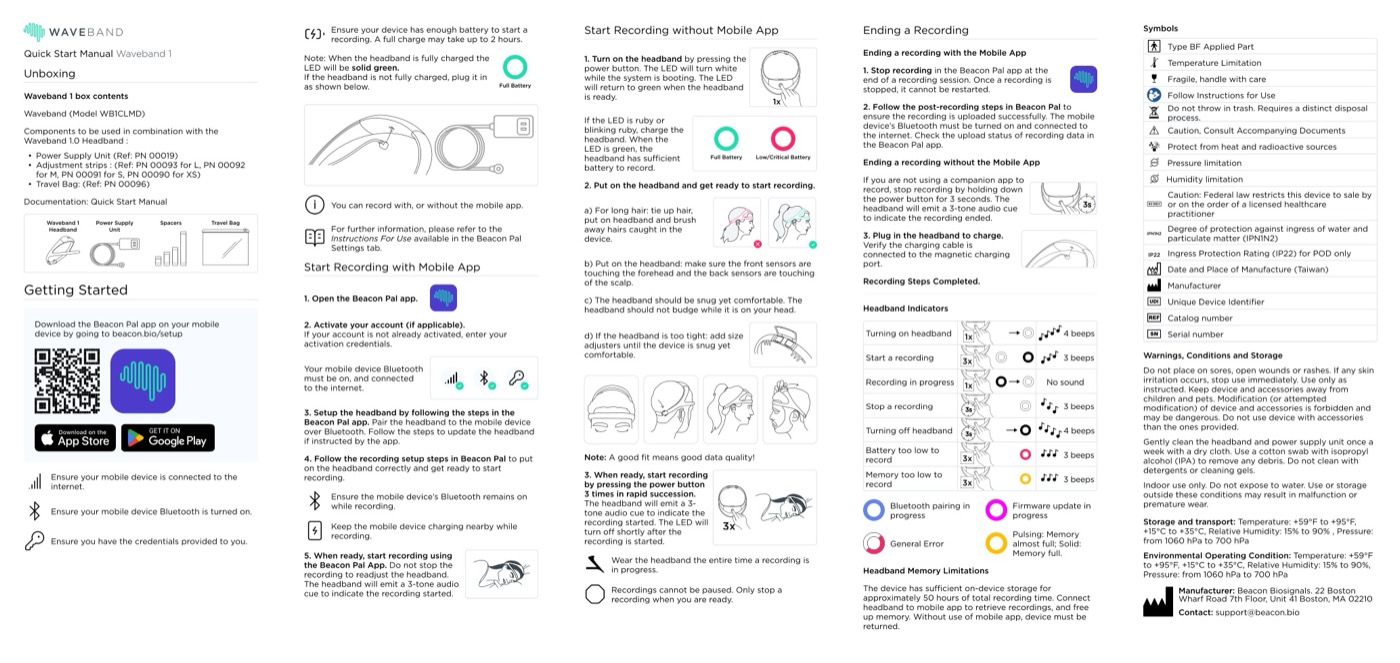
The setup page offers a "Dreem 3S Quick Start Manual" (setup). Home page alt text says "Dreem 3S headband" (beacon.bio). The older Alfin app describes "the Dreem headband" (App Store).
Renames reach the product first. Documents and listings catch up later.
Audit names on every patient-facing surface. Keep "formerly Dreem 3S" only where clinicians or regulators need it.
Setup page asks patients to choose
Documents for four devices and an older app sit side by side (setup).
The page also serves trial sites and clinics with older devices.
Link the card and app to a page for the patient's own kit. Keep the full library for study teams.
Merge now: kit provisioning and support, because Denise sees them.
Merge later: shipping, returns, and scoring.
Keep separate: reprocessing, because each device has its own cleaning and test steps.
Assumption These tags are mine, to validate with operations leads.
The deliverables, before and after
1. Doctor report
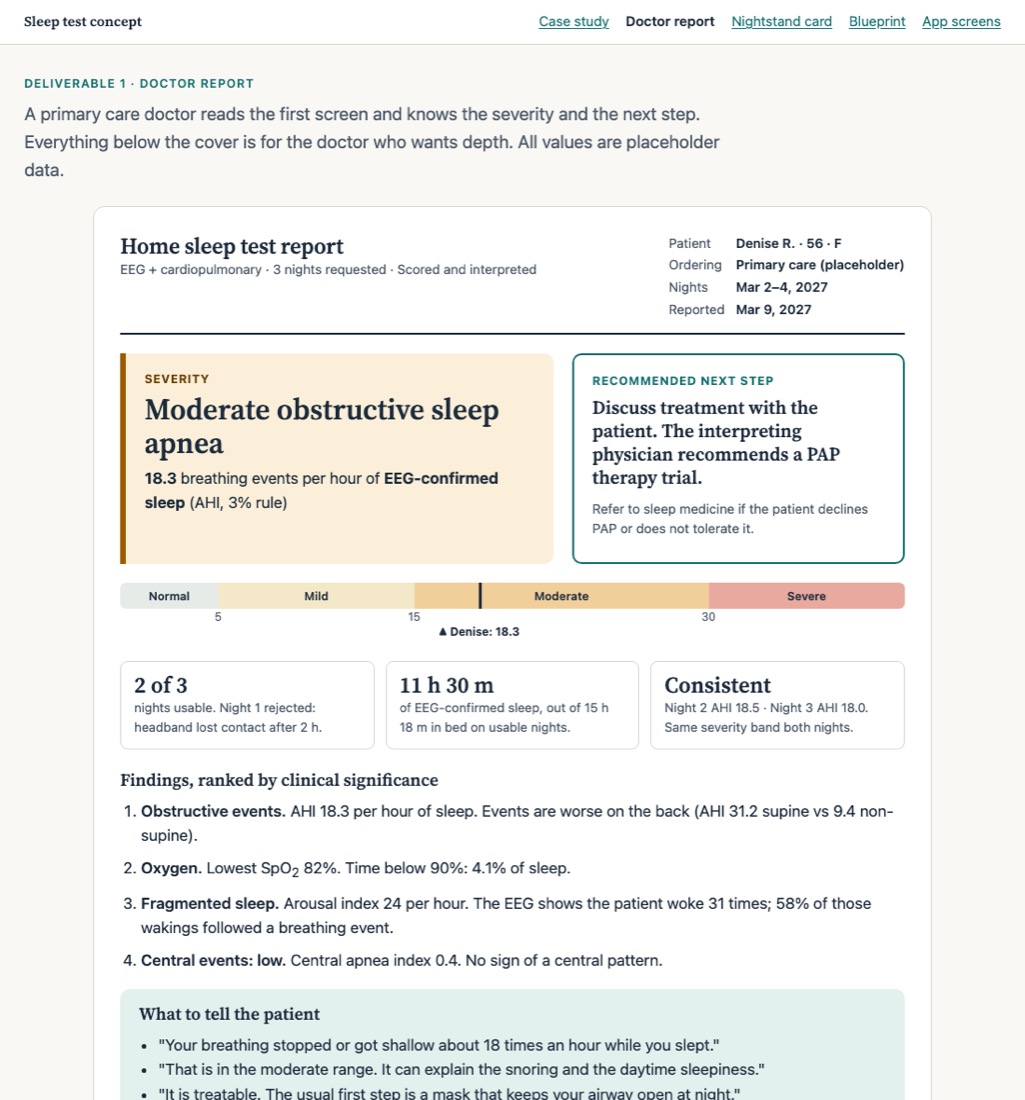
The cover answers the doctor's question first: severity, then next step. Below that is valid sleep time against time in bed, which is what EEG adds. In the placeholder data, the same 210 events give 18.3 per hour of sleep (moderate) but 13.7 per hour in bed (mild). EEG detail comes last. The layout borrows Zio's cover, which ranks findings and puts usable time next to wear time.
Before
Snap's sample report link returns 404. Assumption Current reports follow specialist conventions. In one survey, primary care doctors scored 60% on a sleep apnea knowledge test (JCSM 2015).
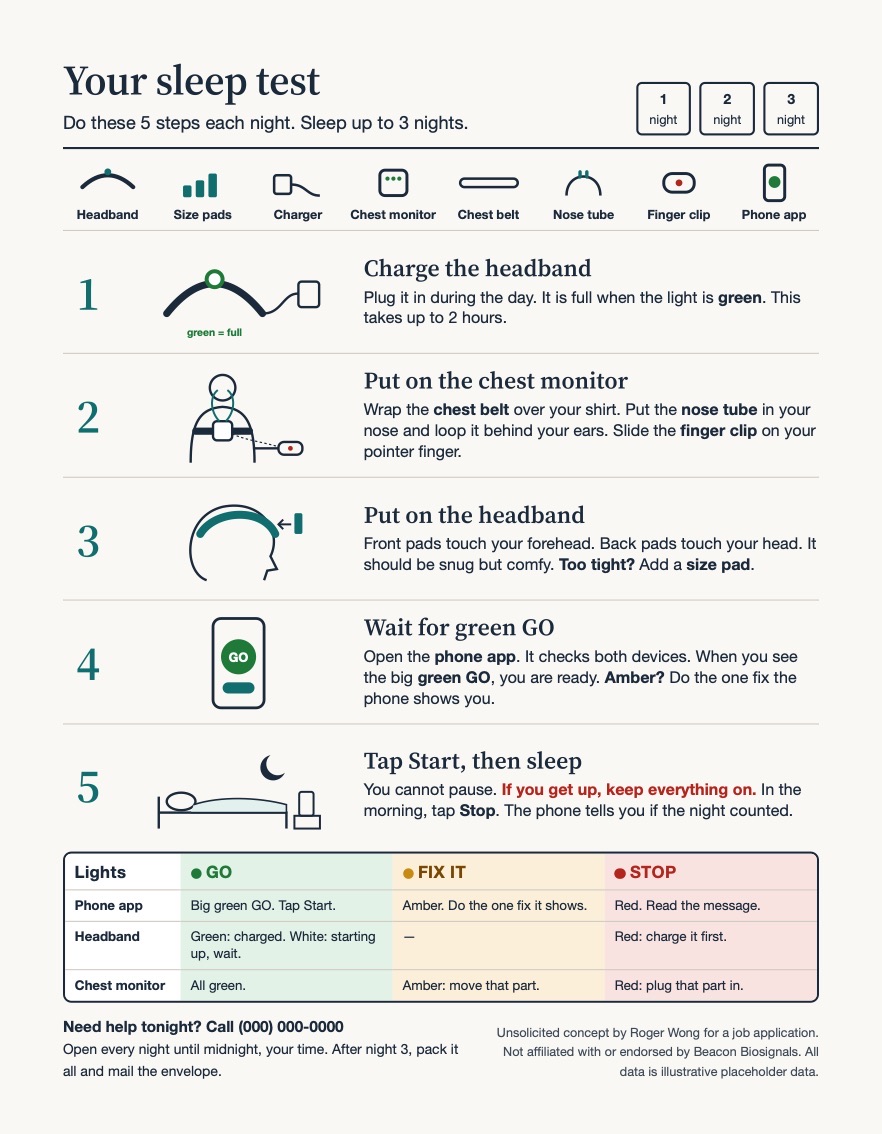
One letter-size page covers both devices in five picture-led steps. Each part has one name: the manual's "adjustment strips," "spacers," and "size adjusters" become "size pad." Every light follows one rule: green is go, amber is fix it, red is stop.
Before
See eight annotated problems, including a battery light that means "charge it" in English and "it is charging" in Spanish.
After
Print PDF · letter, 0.125 in bleed, 9 pt minimum, CMYK-safe colors
3. App screens
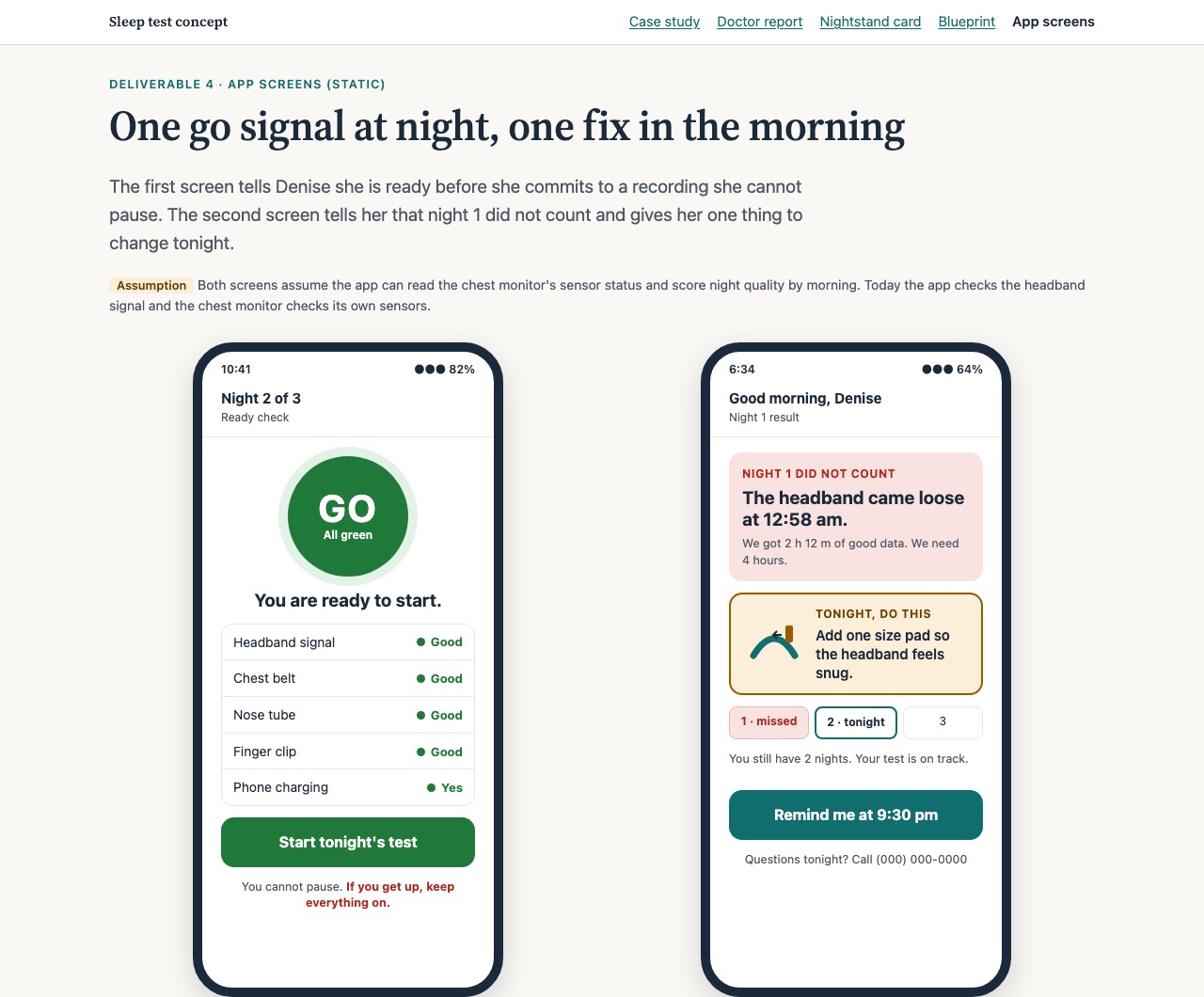
The fit check gives one GO for both devices before a recording Denise can't pause. The morning screen says night 1 didn't count, why, and one fix for tonight. Both screens assume the app can read the chest monitor, which it can't today.
Before
Each device checks itself. Beacon Pal checks the headband signal, and the headband light goes dark once recording starts. The chest monitor runs a Sensor Check before and a Smart Check after (SleepView Monitor). The headband gives no morning result. This concept joins the checks into one answer.
Beacon can count each of these from kit and report data. Without baselines, the goal is direction: up for the first two, down for the last two.
Metric
Definition
Moved by
First-night success rate
Share of kits where night 1 meets the minimum valid sleep time
Nightstand card, fit check screen
Usable nights per kit
Valid nights returned, out of nights requested
Morning result screen, nightstand card
Support contacts per kit
Calls, emails, and chats per shipped kit, split by setup and overnight
Nightstand card, one part name, one light rule
Report-to-decision time
Days from report delivery to a documented next step by the ordering doctor
Doctor report cover
What shipping would require
These are medical device materials, so changes ship through the quality system, with Quality and Regulatory involved from week one.
Use-related risk analysis (IEC 62366-1). List each task, how it can fail, and the harm. Example: stopping a recording to adjust the headband loses the night and delays the doctor's decision.
Formative testing. Test the card and screens with people like Denise, at a bedside, without help. Fix what fails. Test the Spanish card with native Spanish readers.
Summative validation. Test the final design on critical tasks with representative users, under an approved protocol. File the evidence in the design history file.
Regulatory labeling and indications for use stay word for word. The concept only moves them to the instructions for use and device label.
What I'd validate first
Everything here comes from one day of desk research. These are the questions I'd ask users in week one.
A patient like Denise
Walk me through last night's setup. Where did you stop and reread?
What did you think the lights meant? What did you do next?
If something felt wrong at midnight, who would you have called?
What made you decide to mail the kit back?
A sleep technologist
What are the top three reasons a night gets rejected today?
Which of those could the patient have fixed the next night?
How soon after a night could you tell the patient it failed?
What do patients say when they call?
A primary care doctor
Show me what you read first in a sleep report, and what you skip.
What would make you comfortable starting PAP yourself instead of referring?
What do you tell a patient when the result is "inconclusive"?
Where does this report land in your inbox, and when do you read it?
Why I took this on
I co-founded Ona and led design there for 12 years. We built data tools, including OpenSRP and Ona Data, for health workers in low-connectivity, multilingual settings. Field research taught me to design for someone working alone, in their second language.
I started in graphic design and print production, so the nightstand card is built for a press as well as a screen. At Frog I worked on projects spanning hardware, print, and screens (under NDA): one person's experience across a device, the paper in the box, and the app.
I have no sleep medicine or medical device background. This concept is how I'd start learning the domain.